
ENTEBBE, Uganda - piece of timber may look like ordinary wood, but inside its cells lies evidence that can help establish what species it belongs to and whether it matches the documentation accompanying it, writes Walukamba Aldon.
At Uganda’s National Timber and Wildlife Forensic Laboratory in Entebbe, scientists are using DNA analysis to strengthen investigations into illegal timber trade and support enforcement of forestry laws.
The laboratory has developed a timber DNA database covering 74 timber species, according to Dr Patrick Ilukol Chiyo, Manager of the National Timber and Wildlife Forensic Laboratory. The database includes 50 species identified as being illegally acquired and exported through and out of Uganda.
The development is an important step in Uganda’s fight against illegal timber trade because forensic analysis can provide scientific evidence beyond visual identification.
The laboratory was upgraded by the Government of Uganda with support from the European Union funding and its partners, as part of broader efforts to strengthen forest governance, enforcement and sustainable management under the Partnering for Forests Development Programme.
The European Union has committed €40 million to Uganda’s efforts to tackle deforestation and promote reforestation, improve livelihoods through promotion of forest related incomes and enhance biodiversity, with the forest partnership supporting areas including forest governance, institutional strengthening and improved capacity to investigate and prosecute forest crime.
How timber forensics works
So, what happens when a suspected illegal timber consignment reaches the laboratory?
1. The exhibit arrives with documentation
The process begins when investigators deliver a timber exhibit to the laboratory.
Laboratory analysts first examine the accompanying documentation and record information relating to the exhibit, including its identification, origin and chain of custody.
Emmanuel Muhumuza, a Laboratory Analyst, explains that protecting the exhibit from contamination or alteration is critical from the moment it is received.
The laboratory checks whether the physical timber corresponds with the documentation presented by the enforcement team, transporter or trader.
Where there is a significant discrepancy between the documentation and the physical exhibit, the investigation may be halted because the chain of custody or integrity of the evidence has been compromised.
2. A representative sample is collected
Scientists do not necessarily need an entire log or large piece of timber for DNA analysis.
Using specialised equipment, including drills, bits and appropriate cutting tools, analysts collect a small sample from the timber under controlled conditions.
The laboratory avoids unnecessarily transporting bulky exhibits, particularly where only a small quantity is required for scientific analysis.
The collected material is carefully packaged, protected and transferred for laboratory processing.
3. Scientists target the part with more DNA
Once the timber enters the laboratory, analysts examine the wood and identify suitable material for sampling.
According to Muhumuza, sapwood is particularly useful because it generally contains more viable cells and therefore provides better material for DNA extraction than older heartwood.
The first material drilled from the timber may be discarded because surface contamination, including fungi, can interfere with the analysis.
4. Timber cells are broken open
The wood sample is reduced to fine material and mixed with specialised beads.
The mixture is placed in a bead-beating machine, which vigorously agitates the sample. The purpose is to break open the cell membranes and release DNA contained within the timber cells.
This is a critical stage because the DNA must be freed from the surrounding cellular material before it can be isolated and analysed.
5. DNA is separated and purified
The processed sample is then subjected to centrifugation and other extraction steps.
The centrifuge helps separate the different components of the sample, while specialised extraction materials like purified laboratory water help retain the DNA and remove unwanted cellular material, proteins and other substances.
The process is repeated through several stages, at least five to progressively purify the DNA.
By the end of the extraction process, the laboratory has a purified DNA sample suitable for the next stage.
6. PCR identifies the timber
The purified DNA is then subjected to Polymerase Chain Reaction (PCR).
PCR amplifies specific DNA regions so that they can be detected and compared.
The laboratory uses primers designed to target DNA sequences relevant to particular timber species.
Muhumuza explains that the laboratory targets the species identified in the documentation and then determines whether the DNA obtained from the exhibit corresponds with that claim.
7. DNA is compared with the database
This is where Uganda’s growing timber DNA database becomes particularly important.
The laboratory compares the DNA profile obtained from the timber with reference profiles stored in its database.
Dr Ilukol Chiyo says the database has enabled the laboratory to analyse 74 timber species, providing a growing scientific reference base for investigations.
The power of DNA is that timber that looks similar to another species can potentially be distinguished scientifically.
“In the past, two seeds were found, one bigger and the other smaller, but had the same DNA details of the plant species,” Dr Ilukol Chiyo explains, illustrating how genetic evidence can reveal relationships that physical appearance alone may not establish.
8. The scientific result is matched against the paperwork
The laboratory does not work in isolation.
The DNA findings are matched against information contained in documents presented by anti-wildlife and illegal timber enforcement teams, as well as documentation from people transporting or vending timber products.
As Muhumuza explains, the objective is to establish whether the species identified scientifically corresponds with the species declared in the accompanying documents.
Where the scientific findings contradict the documentation, the results can provide investigators with evidence requiring further investigation.
9. The evidence can support prosecution
The final value of timber forensics is not simply identifying a tree species.
It is about generating scientifically credible evidence that can strengthen investigations and, where appropriate, support prosecution of forestry offences. To - date close to 75 suspects are under investigation and at least two trucks loaded with timber were impoubded.
Dr Ilukol Chiyo says one timber-related case has already been investigated and another is ongoing at the laboratory, including investigations involving species such as mahogany.
From laboratory science to forest protection
The laboratory represents one part of a broader enforcement chain.
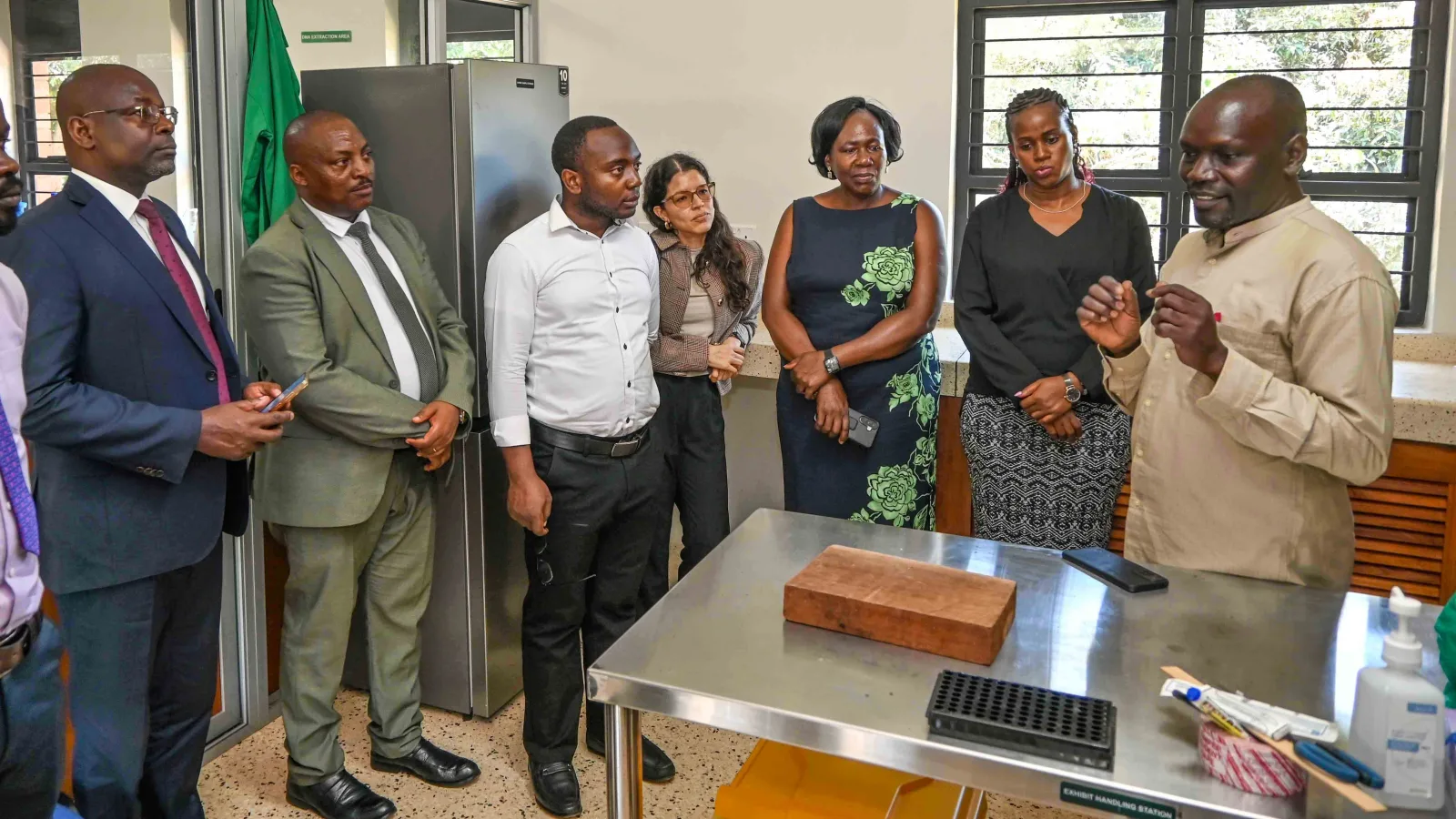
During the 7th Component Technical Committee (CTC) Meeting under the EU-Uganda Forestry Partnership and Programme, members visited the Entebbe laboratory to understand how forensic science is being integrated into Uganda’s response to forest and wildlife crime.
The CTC meeting brought together Government institutions, civil society and development partners under the UNODC component of the partnership. The visit highlighted how science can connect forest monitoring, law enforcement, timber traceability, investigations and the justice system.
Bob Kazungu, Assistant Commissioner in charge of Forest Resources at the Ministry of Water and Environment and CTC Chairperson, said the committee's broad membership reflects the need for institutions to work together.
“We must appreciate that these components speak to each other,” Kazungu said.
Jalia Kobusinge, Advisor, Green Transition, Private Sector Team at the EU Delegation in Uganda and CTC Co-Chairperson, called for continued participation by members and greater focus on priorities jointly agreed by the Government of Uganda and the European Union.
For Alejandra Euceda, UNODC Programme Coordinator, Border Management Branch, Programme Office in Uganda, Division for Operations, timber forensics forms part of a wider package that includes strengthening legal frameworks, training investigators and prosecutors, Judiciary training, Independent Forest Monitoring (IFM), corruption-risk management and inter-agency cooperation.
The EU-backed P4F programme specifically aims to strengthen Uganda's forest governance and contribute to increasing protected, restored and sustainably managed forests while reducing deforestation and facilitating sustainable forest-related trade.
The significance of the Entebbe laboratory therefore extends beyond its walls. Every scientifically analysed timber sample can contribute to a larger system in which forest products are increasingly traceable, documentation can be tested against scientific evidence, and investigators have stronger tools to establish the legality or otherwise of timber.
Uganda's investment in timber DNA forensics, supported by the European Union through the Forest Partnership and implemented under the Partnering for Forests Development project, demonstrates a shift toward a more evidence-based approach to forest governance, where protecting forests increasingly depends not only on what enforcement officers see in the field, but also on what science can prove in the laboratory.
Funded by the European Union under the Partnering for Forests Development Programme, the work contributes to Uganda's wider effort to ensure that forests continue to deliver environmental, economic and social benefits while strengthening the systems needed to combat illegal forest exploitation.