We are committed to ensuring sustainable management of Uganda's water and environment resources for the benefit of present and future generations. Our mission is to promote and ensure the rational and sustainable utilization of water and environment resources for socio-economic development.
Our Mission Statement:
To promote efficient and effective utilization of water and environment resources for a healthy, wealthy and climate resilient population
Vision Statement:
Transformed Ugandan Society with environment and natural resources sustainably managed.
As a Least Developed Country (LDC), Uganda faces challenges such as poverty and infrastructure gaps, but it has made significant progress in education, health, and economic reforms. Despite its negligible contribution to global emissions (0.099 percent), Uganda is highly vulnerable to the impacts of climate change. Ranked 13th in vulnerability and 160th in readiness, the country faces increasingly frequent and severe weather events such as floods, droughts, and erratic rainfall. These extreme events are causing landslides, water shortages, and crop failures and other impacts, which threaten Uganda’s socio-economic progress.Following a request by the state minister for Environment in 2018, Uganda officially joined the Least Developed Countries initiative on Effective Adaptation and Resilience (LIFE-AR) initiative in November 2020. A task force was established to draft a concept note on how LIFE AR would be implemented in Uganda. The concept note recommended the Devolved Climate Finance (DCF) mechanism as the preferred approach to deliver climate finance for local adaptation and resilience building. This mechanism aligns with Uganda’s devolved governance system, integrates climate change into local planning, and supports the country’s NationalClimate Change Policy, Nationally Determined Contribution (NDC) and National Development Plan. The initiative aims to build Uganda’s climate resilience by supporting community-driven climate action, with at least 70% of funding directed toward local priorities.LIFE AR in Uganda will strengthen in-country capabilities, systems and institutions for climate action, ensuring that there’s sustained funding for climate action and that at least 70% of this funding supports community priorities. The LIFE-AR program in Uganda has made significant strides, achieving key milestones in its Test & Evolve phase. Following the establishment phase, the program is being piloted in 12 districts across the countries with four districts of Kalungu, Kibaale, Pader Kaabong into the investment phase.Moving forwardDistrict-Wide Climate Risk and Vulnerability Assessments (CRVAs) completed in all districtsDistrict and sub-county technical awareness meetings conductedPCCC election and training process completedProposal development and investment selection for the first four districts completedInvestment implementation in progress for the first four districts.Date joined: November 2020Current phase: Test & EvolveNumber of districts/sub-districts selected: 12 Pilot DistrictsName of organisation responsible: Ministry of Water and EnvironmentName and function of focal point:Scovia Akot (National Focal Point) - Coordination of the Programme;Harriet Kyomuhendo (Alternate Focal Point)Follow us on social mediaX @LIFEARug
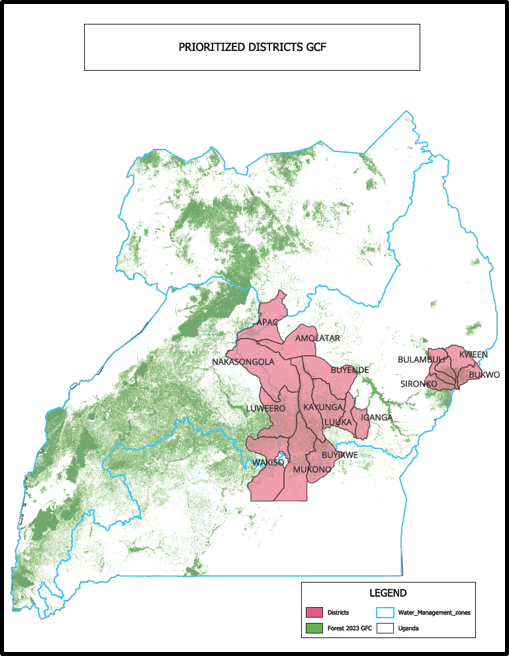
Project summary Between 2016 and 2017, Uganda achieved a major climate milestone by reducing over 8 million tonnes of CO₂ equivalent through targeted efforts to combat deforestation. These results were reported in Uganda’s Biennial Update Report (BUR) and validated through the UNFCCC’s technical assessment and analysis processes. At the 43rd Meeting of the Green Climate Fund (GCF) Board (27–30 October 2025, Songdo, Republic of Korea), the Food and Agriculture Organization of the United Nations (FAO) will present the project “Uganda REDD+ Results-Based Payment for Emission Reductions (2016–2017)”. The proposal seeks a USD 31 million GCF grant to reward Uganda’s verified emission reductions and support continued efforts to halt deforestation and forest degradation. This is the first REDD+ Results-Based Payment project in Africa to be presented to the GCF Board, positioning Uganda as a regional leader in climate mitigation and forest conservation.Forests under pressure Uganda’s forests are facing increasing threats from agricultural and settlement expansion, grazing, and unsustainable wood harvesting for charcoal and timber. These proximate drivers are underpinned by broader socio-economic factors, including, limited economic alternatives, weak governance, insecure land tenure, and rapid population growth.Agricultural conversion for commodities, such as cassava and cattle, is responsible for over 90 percent of forest loss.These pressures are eroding vital ecosystems and accelerating emissions, underscoring the urgent needfor policies and measures that both sustain existing forests and expand forest cover while safeguardingthe rights and livelihoods of forest-dependent communities. This project will build on Uganda’s REDD+Strategy and address the drivers of deforestation and forest degradation through: Sustainable land management and agroforestry; Climate-smart agriculture and sustainable woodfuel production; Community-based pole and timber plantations; and Restoration of natural forests.These strategies aim to relieve pressure on natural ecosystems while promoting carbon removal and long-term sustainability. Agroforestry systems will generate benefits from several sources, including crop yields, timber, firewood, carbon, and watershed protection. Woodlots for both timber and firewood will reduce the distances rural women must walk to collect firewood.
REDD+ is an acronym for Reducing of Emissions from Deforestation and forest Degradation. The plus sign (+) stands for the role of Conservation, Sustainable Forest Management and Enhancement of Carbon Stocks (REDD+). The (+) enhances the land’s capacity for carbon storage through activities that improve forest health. In addition to carbon stocks being protected by avoiding forest damage and or clearing of entire forests, measures such as better forest management, conservation, restoration, and afforestation also increase carbon stocks. Read the Redd+ Programme writeup in the publications on this page.Biomass Degradation in Uganda-Annex 9Uganda has a rich source of data from a variety of forest inventories that have been conducted over the last twenty years and therefore is fortunate enough to be able to analyse the occurrence of forest degradation in some of the inventory sites that have been revisited over the years.Resettlement Process Framework for Uganda’s National REDD+ Strategy and Action PlanUganda has completed drafting its National REDD+ Strategy and Implementation Plan, Feedback Grievance and Redress Mechanism (FGRM), Benefit Sharing Arrangements (BSA), Strategic Environmental and Social Assessment (SESA), and the Environmental and Social Management Framework (ESMF). The implementation of REDD+ National strategy as a long-term measure for tackling deforestation and forest degradation, while meeting the demands for wood, energy and other forest products may come with displacement of people. Some of the REDD+ options may cause displacements; it is therefore necessary to have a Resettlement Policy Framework (RPF) to provide guidance.Safeguards Information System for National REDD+Parties to the United Nations Framework Convention on Climate Change (UNFCCC) agreed at the Conference of Parties (COP) in Cancun in December 2010 to promote and support seven safeguards when undertaking REDD+ activities and requested countries to develop a system for providing information on how these safeguards are being addressed and respected throughout the implementation of REDD+ activities. Uganda is developing a Safeguards Information System (SIS) to meet this commitmentIndigenous Peoples’ Planning Framework June 2021The realization of REDD+ Strategies in Uganda requires inclusion and participation of every stakeholder that matters, affected or may be affected. However, the inclusion and participation of the forest dependent indigenous peoples (FDIP) tend to be very limited in the current planning processes. In view of this, what would be very important for FDIP, and have impacts in their livelihoods and rights are either not captured or addressed inappropriately.Process Framework for Implementation of Uganda’s National REDD+ ProgrammeAs per the World Bank environmental and social risks screening, the Government of Uganda is required to develop a Process Framework (PF). A process framework is prepared when Bank-supported projects may cause restrictions in access to natural resources in legally designated protected areas. The purpose of the process framework is to establish a process by which members of potentially affected communities participate in design of project components, determination of measures necessary to achieve the objectives of ESS5 (see box below), and implementation and monitoring of relevant project activities.Feedback and Grievance Redress MechanismA Grievance refers to a complaint, a feeling of dissatisfaction, an injustice, a wrong doing, an accusation, or criticism. It may include queries, suggestions and comments. A grievance may be mistaken to be “a case”, however, the two concepts are different. A case is a question contested before Courts of justice or an equivalent legal process.
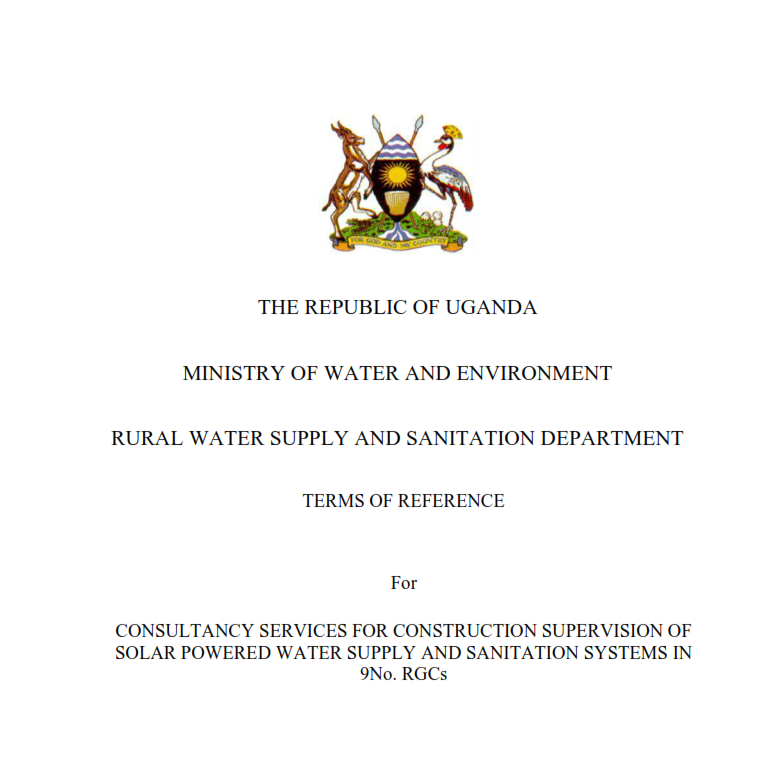
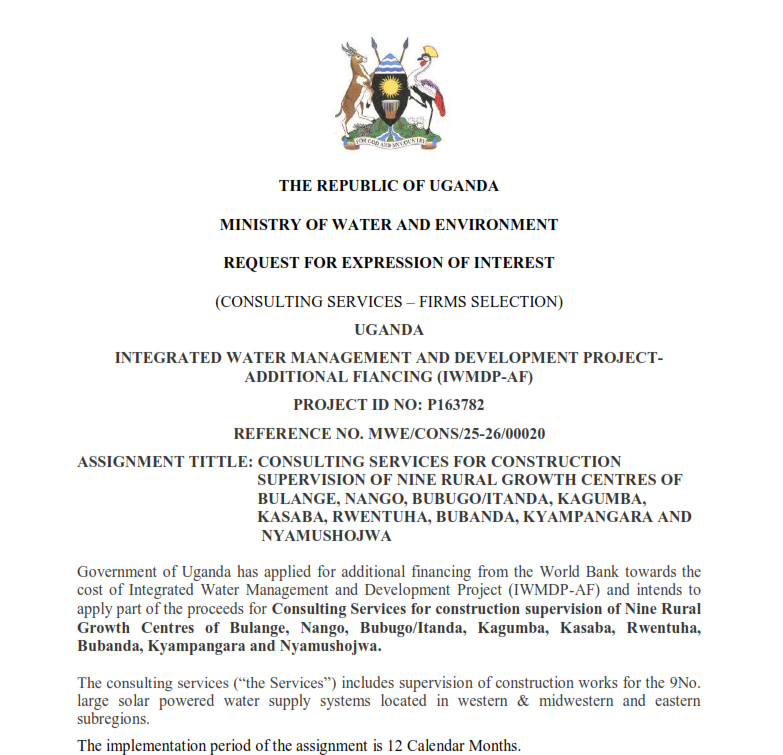
The Water Management and Development Project (WMDP) – Component 2.2 was a vital initiative undertaken by the Ministry of Water and Environment, designed to address pressing water supply and sanitation challenges in eight rapidly growing towns across Uganda. By focusing on both new infrastructure development and the rehabilitation and expansion of existing systems, WMDP significantly improved access to clean water and sanitation services, enhanced public health, and contributed to the long-term sustainability of water resources in these critical urban centers.SUMMARY OF THE RAP REPORT FOR KALIRO NAMUNGALWEThe Government of Uganda secured financing from the International Development Association (The World Bank) to implement the Integrated Water Management and Development Project (IWMDP). The Integrated Water Management and Development Project (IWMDP) is a follow on from the Water Management and Development Project (WMDP) and is being implemented by Ministry of Water and Environment, Urban Water Supply and Sewerage Department (Small Towns and Rural Growth Centres) together with National Water & Sewerage Corporation (large towns). The project will focus on; improving access to water supply and sanitation services in urban, small town and rural areas including refugee hosting communities in the country; improving water resources management; and Institutional strengthening to ensure improved service delivery and sustainable water resources management in Uganda. One of the beneficiaries under IWMDP is Kaliro-Namungalwe cluster towns located in Iganga & Kaliro Districts respectively. The benefiting centers are; towns of Iganga and Kaliro and rural growth centers and subcounties of Nakalama, Namungalwe, Nambale and Nabitende in Iganga District, whereas the benefiting trading centres in Kaliro district include Silver ward, Kigulu village, Bugumba, Nabikote, Namungalwe, Nasuti, Nambale, Naibiri and Nabitende.The Resettlement Action Plan (RAP) has been developed for Kaliro-Namungalwe Town Water Supply and Sanitation System and explores the resettlement strategies including entitlement matrix and implementation arrangements that would mitigate adverse socio-economic impacts and grievances; and the strategies to mitigate adverse impacts and grievances. SUMMARY OF THE ESIA REPORT FOR NAMASALEThe Government of Uganda secured financing from the International Development Association (The World Bank) to implement the Integrated Water Management and Development Project (IWMDP). The Integrated Water Management and Development Project (IWMDP) is a follow on from the Water Management and Development Project (WMDP) and is being implemented by Ministry of Water and Environment, Urban Water Supply and Sewerage Department (Small Towns and Rural Growth Centres) together with National Water & Sewerage Corporation (large towns). The project will focus on; improving access to water supply and sanitation services in urban, small town and rural areas including refugee hosting communities in the country; improving water resources management; and Institutional strengthening to ensure improved service delivery and sustainable water resources management in Uganda. One of the beneficiaries under IWMDP is Namasale town in Amolatar District. The benefiting centers are; parishes of Kayago, Wabinua and Aweipeko with 20 villages.The Environment and Social Impact assessment (ESIA) has been developed for Namasale Town Water Supply and Sanitation System and explores the likely impacts of the proposed project on the biophysical and social-economic environment hence ensuring promotion of environmental and social sustainability through identifying and implementing appropriate mitigation measures proposed.KALIRO-NAMUNGALWE ESIA FINAL APPROVED BY WORLD BANKThe Government of Uganda secured financing from the International Development Association (The World Bank) to implement the Integrated Water Management and Development Project (IWMDP). The Integrated Water Management and Development Project (IWMDP) is a follow on from the Water Management and Development Project (WMDP) is being implemented by Ministry of Water and Environment, Urban Water Supply and Sewerage Department (Small Towns and Rural Growth Centres) together with National Water & Sewerage Corporation (large towns). The project will focus on; improving access to water supply and sanitation services in urban, small town and rural areas including refugee hosting communities in the country; improving water resources management; and Institutional strengthening to ensure improved service delivery and sustainable water resources management in Uganda. One of the beneficiaries under IWMDP is Kaliro-Namungalwe cluster towns located in Iganga & Kaliro District. The benefiting centers are; towns of Iganga and Kaliro and rural growth centers and subcounties of Nakalama, Namungalwe, Nambale and Nabitende in Iganga District, whereas the benefiting trading centres in Kaliro district include Silver ward, Kigulu village, Bugumba, Nabikote, Namungalwe, Nasuti, Nambale, Naibiri and Nabitende.The Environment and Social Impact assessment (ESIA) has been developed for Kaliro-Namungalwe Town Water Supply and Sanitation System and explores the likely impacts of the proposed project on the biophysical and social-economic environment hence ensuring promotion of environmental and social sustainability through identifying and implementing appropriate mitigation measures proposed.FINAL RESETTLEMENT PLAN FOR NAMASALE TOWN WATER SUPPLY AND SANITATION SYSTEM IN AMOLATAR DISTRICTThe Government of Uganda secured financing from the International Development Association (The World Bank) to implement the Integrated Water Management and Development Project (IWMDP). The proposed Integrated Water Management and Development Project (IWMDP) is a follow on from the Water Management and Development Project (WMDP) and will be implemented by Ministry of Water and Environment, Urban Water Supply and Sewerage Department (Small Towns and Rural Growth Centres) together with National Water & Sewerage Corporation (large towns). The project will focus on; improving access to water supply and sanitation services in urban, small town and rural areas including refugee hosting communities in the country; improving water resources management; and Institutional strengthening to ensure improved service delivery and sustainable water resources management in Uganda. The Final Resettlement Plan for Namasale Town Water Supply and Sanitation System in Amolatar District has been finalised and is now ready for use.The RAP will guide the implementation of the corrective construction works for Namasale small towns’ water supply and sanitation systems project.This Report also provides guidelines to stakeholders participating in the mitigation, including rehabilitation/resettlement operations in order to ensure that the project affected persons (PAPs) are not impoverished by the adverse social impacts of the project. Mbale & Small Towns (Busolwe-Kadama-Tirinyi-Kibuku-Butaleja-Budaka) ESIA Final Approved by RSAUganda Government has requested funds from the World Bank for implementing the Uganda Water Management and Development Project (IWMDP). The IWMDP was developed under the Ministry of Water and Environment (MWE) as an integrated water resource management and development project with objectives of improving integrated water resources planning, management and development; and access to water and sanitation services in priority urban areas and rural growth centers. It is believed that the project will contribute to higher level goals of sustaining natural resources, improving service delivery,and increasing economic productivity. Part of the IWMDP funds is intended to be applied towards Water Supply and Sanitation Project in Mbale NWSC service area and neighbouring small towns and rural growth centres of Busolwe, Kadama, Tirinyi, Kibuku, Butaleja and Budaka.National Water & Sewerage Corporation (NWSC) is the implementing agency in Mbale Municipality while MWE through the Directorate of Water Development (DWD) is directly in charge with the small towns.Piped water will be extended from the NWSC Mbale Service Area to the neighbouring small towns and rural growth centres. The NWSC was established as a government parastatal organisation in 1972 to develop, operate, and maintain water supply and sewerage services in urban areas of Uganda.Final ESMF IWMDP-March 2018-Approved by Bank’s RSAThe proposed Integrated Water Resources Management and Development Project (IWMDP-P163782) is a follow-on from the Water Management and Development Project (WMDP-P123204) and will be implemented by the Government of Uganda through the Ministry of Water and Environment. The proposed project’s development objective (PDO) is to improve access to water supply and sanitation services, and strengthen the capacity for water resources management in project targeted areas.
As a Least Developed Country (LDC), Uganda faces challenges such as poverty and infrastructure gaps, but it has made significant progress in education, health, and economic reforms. Despite its negligible contribution to global emissions (0.099 percent), Uganda is highly vulnerable to the impacts of climate change. Ranked 13th in vulnerability and 160th in readiness, the country faces increasingly frequent and severe weather events such as floods, droughts, and erratic rainfall. These extreme events are causing landslides, water shortages, and crop failures and other impacts, which threaten Uganda’s socio-economic progress.Following a request by the state minister for Environment in 2018, Uganda officially joined the Least Developed Countries initiative on Effective Adaptation and Resilience (LIFE-AR) initiative in November 2020. A task force was established to draft a concept note on how LIFE AR would be implemented in Uganda. The concept note recommended the Devolved Climate Finance (DCF) mechanism as the preferred approach to deliver climate finance for local adaptation and resilience building. This mechanism aligns with Uganda’s devolved governance system, integrates climate change into local planning, and supports the country’s NationalClimate Change Policy, Nationally Determined Contribution (NDC) and National Development Plan. The initiative aims to build Uganda’s climate resilience by supporting community-driven climate action, with at least 70% of funding directed toward local priorities.LIFE AR in Uganda will strengthen in-country capabilities, systems and institutions for climate action, ensuring that there’s sustained funding for climate action and that at least 70% of this funding supports community priorities. The LIFE-AR program in Uganda has made significant strides, achieving key milestones in its Test & Evolve phase. Following the establishment phase, the program is being piloted in 12 districts across the countries with four districts of Kalungu, Kibaale, Pader Kaabong into the investment phase.Moving forwardDistrict-Wide Climate Risk and Vulnerability Assessments (CRVAs) completed in all districtsDistrict and sub-county technical awareness meetings conductedPCCC election and training process completedProposal development and investment selection for the first four districts completedInvestment implementation in progress for the first four districts.Date joined: November 2020Current phase: Test & EvolveNumber of districts/sub-districts selected: 12 Pilot DistrictsName of organisation responsible: Ministry of Water and EnvironmentName and function of focal point:Scovia Akot (National Focal Point) - Coordination of the Programme;Harriet Kyomuhendo (Alternate Focal Point)Follow us on social mediaX @LIFEARug
The Ministry of Water and Environment is committed to avoiding, minimizing, and mitigating adverse environmental and social impacts associated with its projects, as well as adopting a gender-sensitive and gender-equitable approach for all its projects.
.png)
.png)


.png)