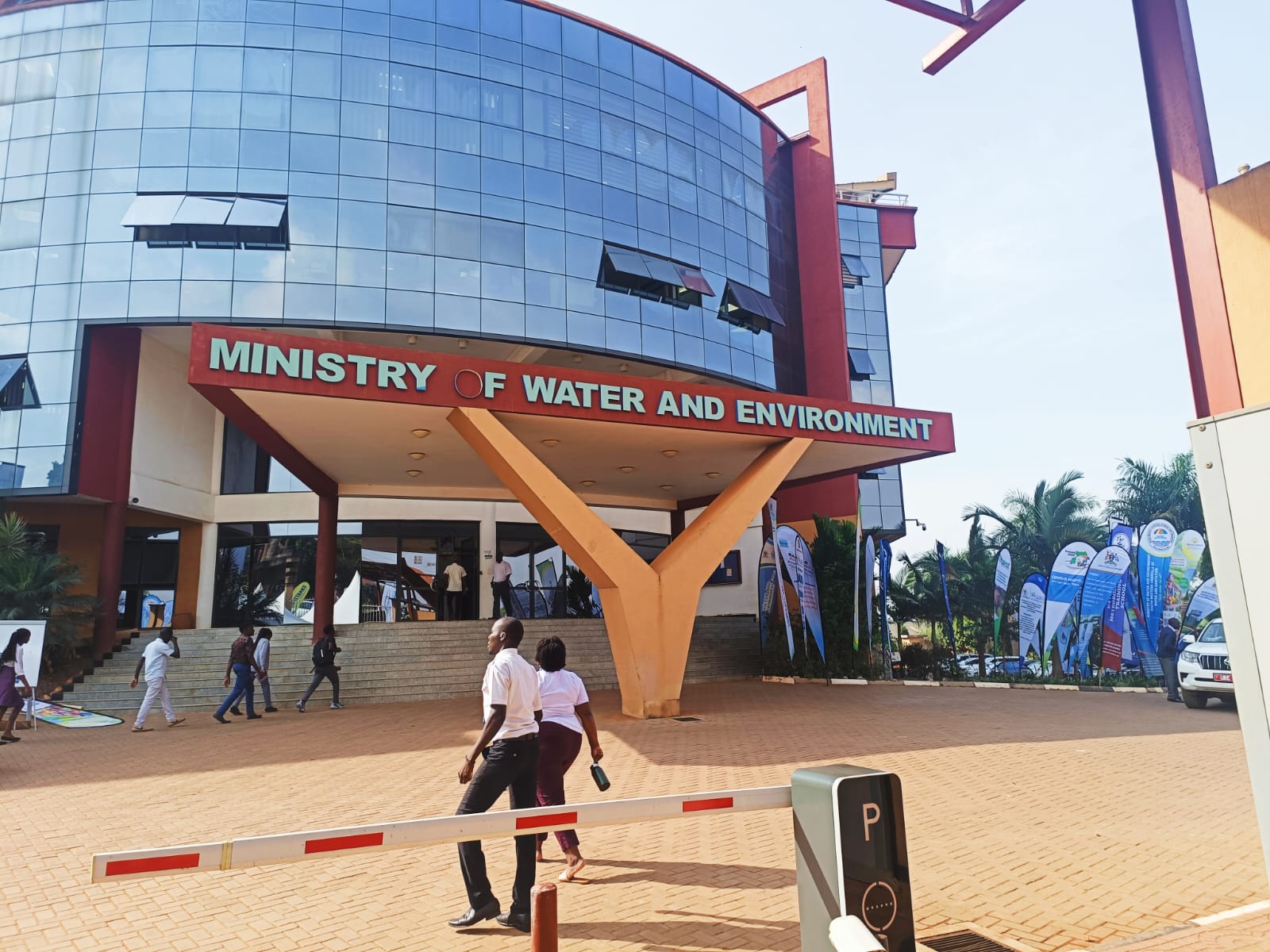
MWE Headquarters

Publications & Documents

200 publications found
Economic Study for water and environment sector-Uganda Factsheet A4

Results of a national integrated bio-physical/economic modeling framework show that from 2015 to 2040 enhanced investment by the Ministry of Water and Environment (MWE) in Water Resource Development and Environmental Management can increase per capita GDP by 9% in 2040. Water resource development investments contribute 45% of this increase, while wetland protection and land management investments (especially efforts to switch away from firewood for cookstoves) yield 55% of the total benefit.

• 0.29 MB
Download • 24 downloads
Economic Study 2018-Contribution of Water Development and Environment Resources to Ugandas Economy

The study is a partnership between the Industrial Economics (IEc) expert team and staff, the Ministry of Water and Environment (MWE) team, and other local counterparts in Uganda. From the government of Uganda, we are grateful for policy guidance and technical support provided by the Ministry of Water and Environment, the Ministry of Energy and Minerals Development, the Ministry of Finance, Planning and Economic Development, the Nile Basin Initiative, and to the study focal points within these Ministries whose participation made this study possible.

• 1.14 MB
Download • 20 downloads
Water Governance Newsletter

The Ministry of Water and Environment (MWE) and the water and environment sector in general is increasingly prioritizing governance activities through its Good Governance Working Group. This year, the sector has prioritized the development of a good governance indicator to be used in measuring and monitoring of processes the sector undergoes in service delivery.

• 1.19 MB
Download • 19 downloads
ENR GENDER STRATEGY 2016 -2021

’Women play an essential role in the management of natural resources, including soil, water, forests and energy and often have a profound traditional and contemporary knowledge of the natural world around them’’ (World Bank).However, attention needs to be paid on the differential cause and effect of environmental degradation on men and women; and importantly, the role of women as agents of change in mitigation and adaptation to the changing environment. It is very true that men and women use resources differently and have different roles in society. However, in order to be effective, strategies to preserve and sustain the environment should pay close attention to the impact of the disparities between women and men’s access to environmental and natural resources and opportunities.

• 1.04 MB
Download • 14 downloads

This volume is a product of the staff of the International Bank for Reconstruction and Development/ The World Bank. The findings, interpretatioand conclusions expressed in this paper do not necessarily reflect the views of the Executive Directors of The World Bank or the governments threpresent. The World Bank does not guarantee the accuracy of the data included in this work. The boundaries, colors, denominations, and otinformation shown on any map in this work do not imply any judgment on the part of The World Bank concerning the legal status of any territory the endorsement or acceptance of such boundaries.

• 0.88 MB
Download • 22 downloads
Uganda Catchment Management Planning Guidelines-revised-Sep2017

These guidelines were prepared by the Directorate of Water Resource Management of the Ministry of Water and Environment with technical support of the World Bank (2014 edition) and Expertise France (2017 edition). Input and guidance was gratefully received from various DWRM staff at the centre and in the Water Management Zones, key stakeholders involved in catchment-based water resources management activities and many other people and organisations who took part in the consultation process. Financial support for preparation and printing of the documents was provided by the World Bank.

• 0.37 MB
Download • 23 downloads
Manuals • Manuals

WSDF Operations Manual

The Water and Sanitation Development Facility (WSDF) is a unit of the Directorate of Water Development under the Ministry of Water and Environment. It funds and implements water and sanitation facilities across all regions of Uganda. The WSDF model began in the South-West in 1996, leading to the formal creation of WSDF-SW in 2006 and three more branches—Central, East and North—during the 2008/09–2012/13 support programme. The Facility designs and constructs water and sanitation systems for Small Towns, Town Boards and Rural Growth Centres.

• 2.26 MB
Download • 22 downloads

The Water Sources Protection Guidelines for Piped Water Supply Systems outline the steps required to develop a Water Source Protection Plan. This Volume draws from the broader Framework for Water Sources Protection Guidelines (Volume 1) but focuses on the specific actions, procedures and considerations most relevant to safeguarding water sources for piped water supply schemes. Developed as a standalone reference, the Volume enables practitioners involved in piped water supply systems to apply the guidance effectively. Users may, however, consult Volume 1 where necessary to ensure proper interpretation within the wider framework for water source protection.

• 0.78 MB
Download • 17 downloads

The Water Sources Protection Guidelines for multipurpose reservoirs outline the steps required to prepare a Water Source Protection Plan. This Volume is based on the broader Framework for Water Sources Protection Guidelines (Volume 1) but highlights the specific actions, procedures and considerations most relevant to safeguarding water sources for multipurpose reservoirs and valley tanks. Designed as a standalone reference, the Volume supports practitioners responsible for reservoir management in applying the guidelines effectively. Users may, however, consult Volume 1 where needed to ensure that the guidance is properly interpreted within the wider framework for water source protection.

• 0.65 MB
Download • 14 downloads

The Water Sources Protection Guidelines for Point Source Water Supply Systems outline the steps required to prepare a Water Source Protection Plan. This Volume is drawn from the broader Framework for Water Sources Protection Guidelines (Volume 1) but highlights the specific actions, procedures and considerations most relevant to protecting water sources for piped water supply schemes. Designed as a standalone reference, the Volume enables practitioners involved in piped water supply systems to apply the guidance effectively. Users may, however, refer to Volume 1 where necessary to ensure proper interpretation within the wider framework for water source protection.

• 0.38 MB
Download • 11 downloads

The Water Sources Protection Guidelines for hydroelectric power plants outline the steps required to develop a Water Source Protection Plan. This Volume draws from the broader Framework for Water Sources Protection Guidelines (Volume 1), but highlights the specific actions, considerations and procedures most relevant to safeguarding water sources for small to medium hydroelectric schemes. Designed as a standalone reference, this Volume enables stakeholders to apply the guidelines directly to hydroelectric power operations. Users may, however, consult Volume 1 where necessary to ensure proper interpretation within the wider framework for water source protection.

• 0.60 MB
Download • 13 downloads