
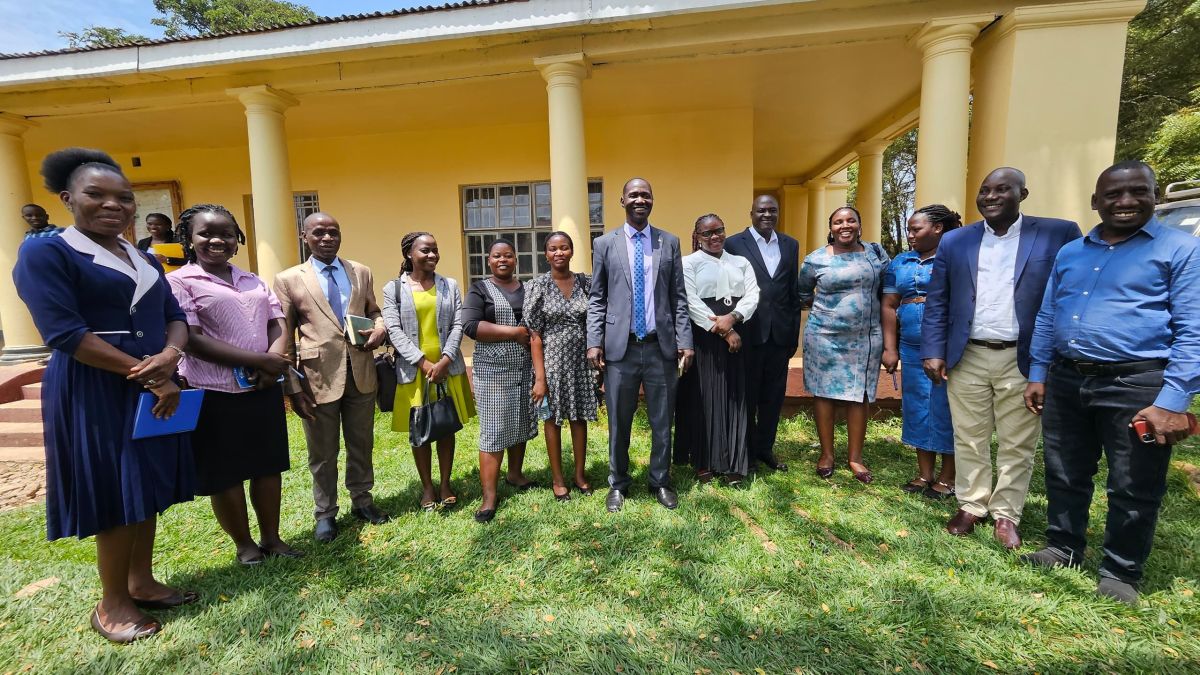
Ministry of Water and Environment, Jinja District Harmonize Plans to Reopen Namavundu Central Forest Reserve Boundaries
The Ministry of Water and Environment (MWE) has agreed on a modus-operandi with Jinja District officials to set the ground for reopening the boundaries of the 704-hectare Namavundu Central Forest Reserve, aiming to curb forestry and environmental degradation.
The high-level stakeholder engagement, held at the Jinja District headquarters on Tuesday, forms part of a broader five-year conservation initiative for the Kalagala and Itanda Falls Conservation Area. The project, co-implemented by the Department of Environmental Management and Protection, and the Department of Forestry Management and fully funded by the Government of Uganda, covers key ecosystems across Kayunga, Kamuli, Buikwe, and Jinja districts, as well as Jinja City. These key ecosystems include the River banks and the Central Forest Reserves of Namavundu, Itanda and Kalagala Falls.
MWE's delegation was received by LC5 Chairperson Mr. Moses Batwala, Deputy LC5 Mr. Joseph Ikola, Chief Administrative Officer (CAO) Mr. Emmanuel Wamburu, and Deputy CAO Mr. Hussein Malunda.
Speaking during the meeting, Mr. Leo Twinomuhangi, team leader from MWE stressed that the boundary exercise is purely legal and consultative, rather than an eviction drive.
"Our main focus is to prepare a successful project through a transparent, legal, and mutually agreed-upon process that minimizes conflicts with adjacent communities," Mr. Twinomuhangi said. "Ministry surveyors will rely on original 1932 gazette plans to re-establish visible boundary marks."
District leaders pledge full support for the exercise
The CAO Mr. Emmanuel Wamburu confirmed that technical staff have been strictly instructed to block illegal land titling in protected areas.
"Land does not expand, yet our population grows daily, creating immense pressure," Mr. Wamburu noted. "We must hold ourselves accountable and set high standards for our communities."
Deputy CAO Mr. Hussein Malunda welcomed the livelihood packages, noting that community buy-in is vital for long-term conservation. While acknowledging that some encroachers are influential individuals, he expressed confidence that inter-agency cooperation would enforce the law effectively.
Aligning with Presidential Directives
The boundary reopening directly supports presidential directives to safeguard Uganda’s forests, wetlands, and riverbanks. Mr. Twinomuhangi warned that unchecked environmental destruction has worsened natural disasters such as landslides and flooding across the region.
He cited illegal land titling in protected zones including forest reserves, lakeshores, and islands along the River Nile as a major issue driven by impunity. To counter this, the ministry is rolling out comprehensive management plans covering forests, wetlands, and fisheries, alongside environmental audits and strict licensing frameworks.
Alternative Livelihoods & Community Engagement
To ease local pressure on protected land, the ministry will offer alternative economic activities, including beekeeping and sustainable biomass projects. Additionally, free tree seedlings will be distributed to residents from the Kimaka nursery bed.