City Forecast Issued on Sunday 24th August 2025
August-2025-Dekad_2-Agro-meteorological-Bulletin
12-HOURS FORECAST FOR FISHERMEN ON LAKE VICTORIA from 1800 Sunday 17th to Monday 18th August, 2025.
City Forecast Issued on Saturday 16th August, 2025.
The Nalugugu community based management plan (CBWMP) is developed under the “Strengthening the Adaptive Capacity and Resilience of Communities in Uganda’s Watersheds in Awoja Catchment – SACRiAC project” with funding from the Global Environment Facility (GEF) and the African Development Bank. It is presumed that the ten-year plan will ensure the sustainable use and conservation of Nalugugu wetland so that it can provide benefits to the community.
Enhancing Resilience of Communities to Climate Change through Catchment Based Integrated Management of Water and Related Resources in Uganda’’ (EURECCCA) Project. Funded by Adaptation Fund implemented by Sahara and Sahel Observatory and executed by Ministry of Water and Environment through Directorate of Water Resources Management. Launched in 2017 and officially closed in June 2023. Revolving fund component still on-going.
The Government of Uganda (GOU) represented by the Ministry of Water and Environment has received financing from the World Bank towards the cost of the implementation of the Irrigation for Climate Resilience Project (ICRP). The project development objective (PDO) is to provide farmers in the project areas with access to irrigation and other agricultural services, and to establish Operation and Maintenance arrangements for irrigation service delivery.
The Ministry of Water and Environment (MWE) developed and rolled out the Water and Environment Information System (WEIS) to streamline the collection, analysis and dissemination of water and environmental data, information and knowledge products; and to improve data-driven decision making. The WEIS consolidates data from various departments of MWE and integrates with other Ministry, Departments and Agencies of government for data verification and collaborations. In this regard, MWE is publishing the WEIS Beacon, a quarterly information bulletin to improve the awareness, visibility, adoption and usage of the system. Therefore, as a key stakeholder, to access the second issue of the WEIS Beacon, please click the link below.
As Uganda advances toward Vision 2040, the Ministry of Water and Environment (MWE) remains central to achieving the goals of the National Development Plan IV and the Strategic Development Plan for 2025/26–2029/30. The Plan emphasizes climate resilience and socio-economic transformation through sustainable management of water and environment resources. This Strategic Plan guides the Ministry over the five-year period, defining priorities, strategies and targets aligned with the national development agenda and the NDP IV tenfold growth strategy. It provides a clear framework for all water and environment interventions, ensuring they support national objectives in socio-economic development, poverty reduction and sustainable resource management.
City Forecast Issued on Sunday 15th June, 2025
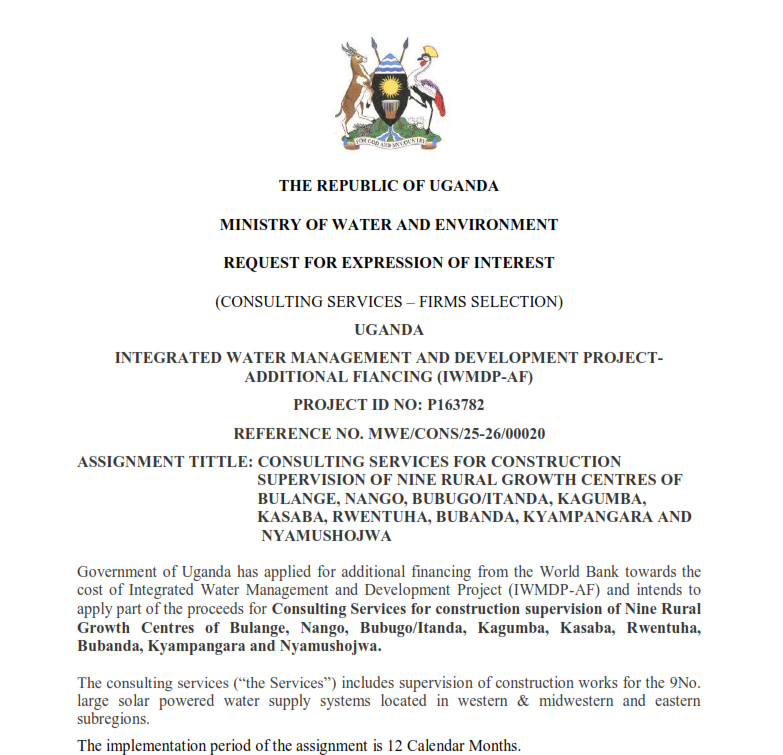
MoWater Advert for Competion works for Kabuyanda
Advert for pipe network
An Environmental and Social Management Framework (ESMF) outlines mechanisms for the screening of proposed project activities and identified potential environmental and social impacts and their subsequent management.
City Forecast Issued on Monday 07th April, 2025
The Ministry of Water and Environment (MWE) developed and rolled out the Water and Environment Information System (WEIS) to streamline the collection, analysis and dissemination of water and environmental data, information and knowledge products; and to improve data-driven decision making. The WEIS consolidates data from various departments of MWE and integrates with other Ministry, Departments and Agencies of government for data verification and collaborations. In this regard, MWE is publishing the WEIS Beacon, a quarterly information bulletin to improve the awareness, visibility, adoption and usage of the system.
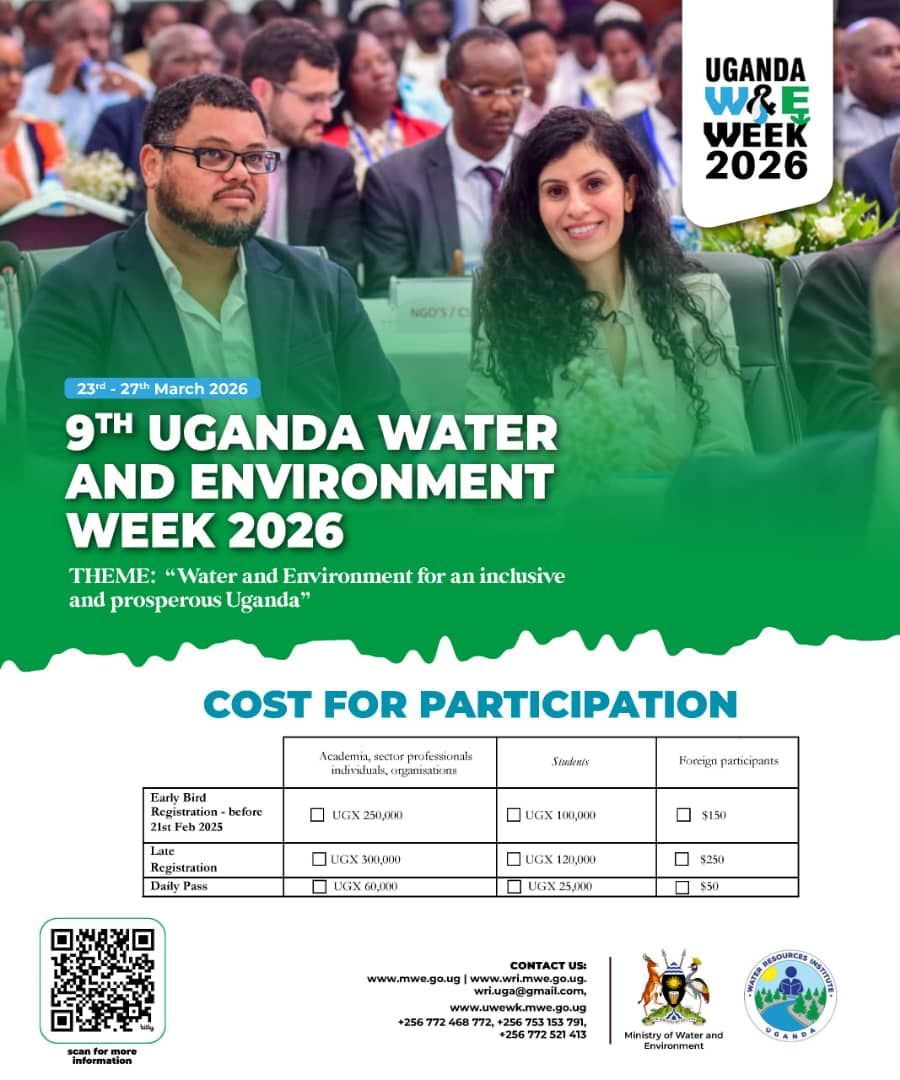
Unlocking Economic Growth through Water and Environmental Sustainability: Prof. Edward Bbaale’s Keynote on Global Challenges and Solutions. Speaking at the 8th Uganda Water and Environment Week (UWEWK) 2025 under the Ministry of Water and Environment, Prof. Edward Bbaale, Director of the EfD Makerere Centre at Makerere University, noted the critical relationship between water, environmental resources, and economic prosperity. He emphasized that water and environmental resources are not just vital for human survival but are also engines for economic growth. However, he pointed out the paradox of widespread inequality in access to these resources, despite their abundance, and highlighted the urgency of addressing this issue for the future well-being of humanity.
Addressing the Interconnected Crises of Water, and Climate Change In a thought-provoking keynote address, Dr. Daniel Ddiba, a Research Fellow at SEI-Stockholm, shed light on the critical intersection between water, sanitation, and climate change during a recent presentation. The keynote, titled “Water and Environment for Climate Action,” outlined the deep linkages between these sectors and highlighted the urgent need for integrated approaches to tackle the growing climate crisis. Dr. Ddiba began by discussing the profound effects of climate change on the global water cycle, explaining how shifts in precipitation patterns and the increasing frequency of extreme weather events are destabilizing water availability. He pointed out that these disruptions not only affect access to clean water b
A crucial foundation for a peaceful and sustainable future lies in water and environmental management, yet significant challenges persist. On the second day of the Uganda Water and Environment Week (UWEWK) 2025, a keynote presentation shed light on several pressing issues, including water scarcity driven by heightened competition among various user groups such as farmers, pastoralists, urban water supply, and industries. Other concerns included land degradation due to overgrazing, deforestation, and unsustainable farming practices; unequal access to resources; weak governance and institutional frameworks; limited human resources; poorly enforced water permits; climate change; social and political factors; poverty and inequality; and rapid population growth.